How to play
The game at a glance
Start here for the big picture: what you're trying to do, how to read a card, and how your champion and two decks fit together. Then work through the chapters for the details.
How to win
The main way to win is by defeating each opponent's champion. Champions are defeated by damage.
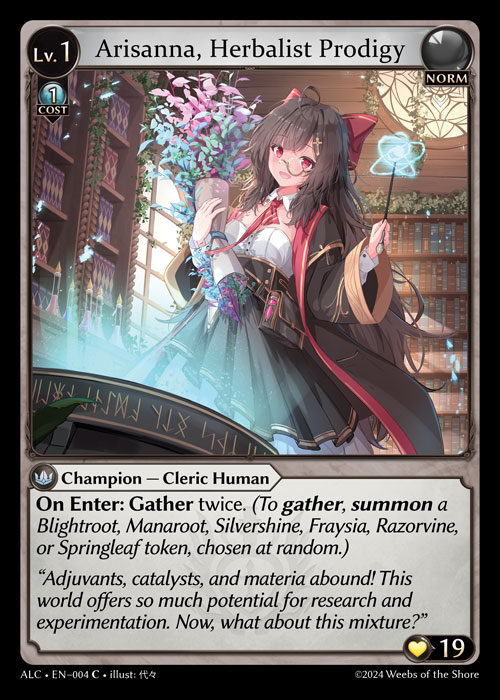
Damage taken
0 / 19
You can also win by decking out an opponent. If a player has to draw a card when their main deck is empty, they lose the game. Running out of cards isn't enough on its own: they lose the moment they try to draw from the empty deck.
If every remaining player loses at the same moment, the game is a draw.
Games are usually played as a best of three. You play up to three games against the same opponent, and the first player to win two of them wins the match. Most events use this format, though an event can choose single games instead, and with friends you can play as many as you like.
Anatomy of a card
Every card has a name, a cost, a type, a class, and an element. Pick a part of the card to see what it means.
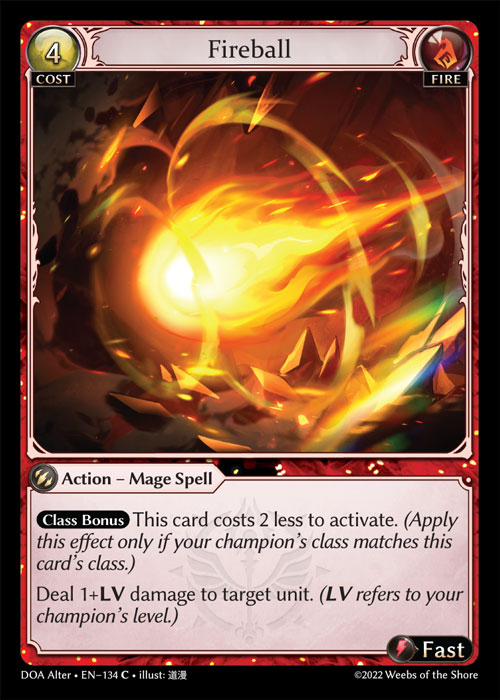
The card's name sits in the top bar, between its cost and its element. Every card name is unique.
Elements
A card's element decides whether you're allowed to play it. Norm cards are always available. Every other element has to be enabled by your champion:
You start with
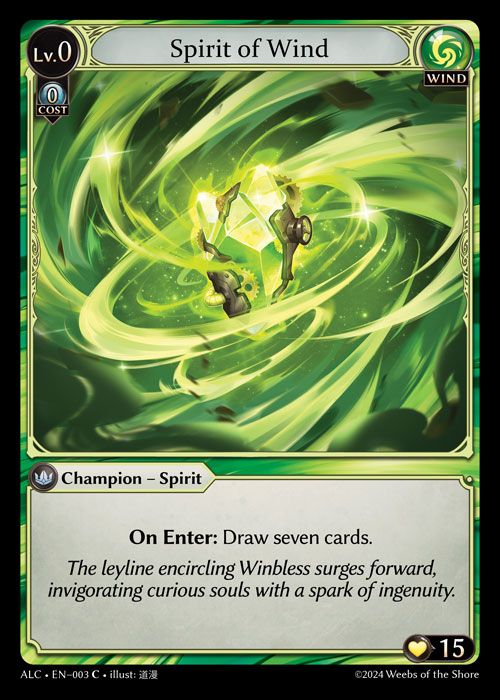
-
 Wind Basic element
You level up into
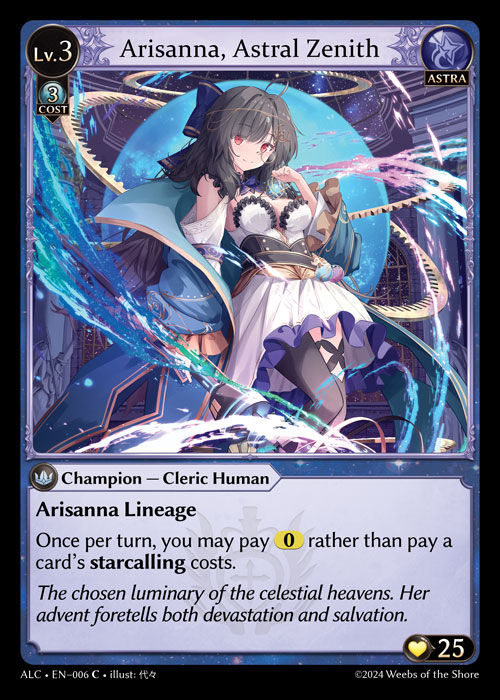
-
 Astra Advanced element
-
 Exalted Special element
Norm
Enabled for every player, always.
-
 Norm
Basic
Enabled by the Spirit you start with, and by any later champion of that element.
-
 Fire
-
 Water
- Wind
Advanced
Enabled by the higher-level champions you level up into.
-
 Arcane
- Astra
-
 Crux
-
 Exia
-
 Luxem
-
 Neos
-
 Tera
-
 Umbra
Special
Enabled while you have a champion that enables an advanced element. Exalted cards carry an EX tag under their element symbol.
- Exalted
Your champion
Your champion is you on the battlefield. Everything in the game revolves around keeping yours alive and defeating theirs.
- Level 0
- Level 1
- Level 2
- Level 3
Spirit of Wind
15 life
You start with a Level 0 Spirit. When Spirit of Wind enters the field, you draw seven cards.
- You start with a Level 0 Spirit. Before the first turn, it's put onto the field from your material deck.
- You level up one step at a time. You can pay a champion's memory cost to put it from your material deck onto the field, on top of your current one. This is called materializing, and the new champion has to be one level higher.
- Your lineage is your history. The pile of champions under your current one is your lineage, and every champion in it still enables its element for you.
- Most champions don't attack on their own. They attack by playing attack cards or by swinging a weapon, which is called wielding it.
- Damage on your champion adds up. Damage on allies is removed at the end of each turn, but damage on a champion stays for the whole game, so every hit counts.
Your two decks
Each player brings two decks. They work very differently.
Main deck
- Your allies, actions, attacks, weapons, items, and more.
- Kept face down and shuffled. You can't look through it during a game.
- You draw your hand from it.
- Its cards use reserve costs: you pay by putting cards from your hand face down into your memory, a pile in front of you that comes back to your hand each turn.
Material deck
- Your champions, and regalia: items, weapons, and allies built to go with them.
- You can look through it at any time.
- Must include a Level 0 champion. When you build your own deck, it can hold only one copy of each card.
- Its cards use memory costs: you pay by banishing cards picked at random from your memory, which removes them from the game.
Card types at a glance
- ChampionMaterial deck
- Your hero. It starts at Level 0 and levels up over the game.
- RegaliaMaterial deck
- Not a type of its own, but a label for items, weapons, and allies that start in your material deck instead of your main deck.
- AllyMain deck
- A creature or character that fights for you. It stays on the field, and it can attack, be attacked, and hit back when attacked.
- ActionMain deck
- A one-time effect. It does what it says, then goes to your graveyard. Its speed, fast or slow, says when you can play it.
- AttackMain deck
- Lets your champion attack. Playing one rests your champion: you turn it sideways to show it has been used this turn.
- WeaponMain deck
- Stays on the field. Your champion can attack with it, and each attack uses up one point of its durability until it breaks.
- ItemMain deck
- Stays on the field until it’s destroyed, usually giving you an ongoing effect or an ability to use.
- DomainMain deck
- Stays on the field and changes the game for as long as it’s there. Some domains can even be attacked.
- PhantasiaMain deck
- Stays on the field until it’s destroyed, and its effects last as long as it’s there.
Some cards also mention tokens, statuses, masteries, or uniques. You don't need them to start playing, and you can look each one up in the official rules glossary when you meet it.