Combat
Every attack starts its own combat phase, which always runs through these steps in this order:
Step 1 of 4
Declare the attack
Choose an awake unit to attack with and rest it. Then choose what it attacks. No one can respond while you declare.
Attacking is how you damage your opponent’s champion and destroy their allies. You attack during your main phase, one attack at a time. When combat ends you’re back in your main phase, where you can attack again with another awake unit.
Who can attack
Champions and allies are both units. Any awake unit you control can attack, and attacking rests it, so each unit attacks once per turn unless something wakes it up.
- Allies attack on their own. An ally deals damage equal to its power. An ally with 0 power can’t attack.
- Allies can attack right away. Allies enter the field awake, so an ally can attack on the turn you play it.
- Champions usually need help. Most champions have no power of their own, so they attack with an attack card, a weapon, or both. A champion that does have power can also attack on its own, just like an ally.
- Not on the first player’s first turn. In a two-player game, the first player can’t attack on their first turn. In a multiplayer game, only the last player in turn order can attack on their first turn.
You choose the target as you declare the attack: your opponent’s champion or one of their allies. You can’t attack your own cards.
Attacking with an ally
An ally attacks with its own power. Say your Horned Knight attacks your opponent’s Dreamy Unicorn. Horned Knight has 2 power, and its text gives it +1 while it’s attacking an ally, so it attacks for 3.
Dreamy Unicorn is awake, so your opponent can rest it to retaliate for its 1 power. In the damage step both hits land at the same time. Dreamy Unicorn has 2 life, so it’s destroyed. Horned Knight survives with 1 damage, which is removed in the end phase.
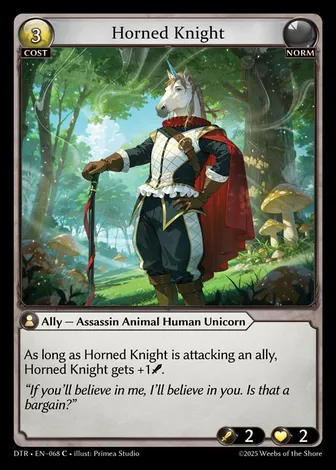
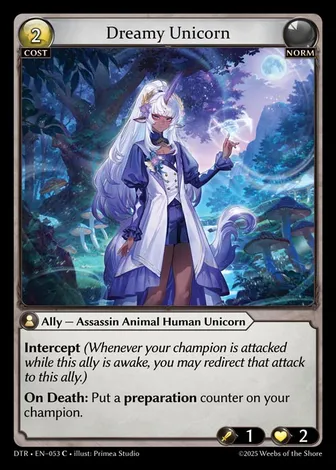
Your Horned Knight and your opponent's Dreamy Unicorn are both awake.
Attacking with your champion
A champion attacks with an attack card, a weapon, or both together.
- With an attack card. You play the attack card from your hand, paying its cost, and resting your champion is part of that cost. Once it’s played, it goes into your champion’s intent, a spot beside your champion where the attack card sits during the attack, and you choose the target.
- With a weapon. You rest your champion and attack with a weapon you control. This is called wielding the weapon.
- With both. When you attack with an attack card, you may also wield a weapon. Say so as you declare the attack. You can’t add a weapon later in combat.
In the damage step, everything in the attack adds up: the attack card’s power, the weapon’s power, your champion’s own power if it has any, and any bonuses. All of it counts as damage dealt by your champion.
Say your champion is Lorraine, Wandering Warrior. When she entered the field, her On Enter ability put Training Sword onto the field from your material deck. Now you play Reckless Slash, an attack card with 3 power, and resting Lorraine is part of its cost. It goes into her intent.
You announce that Lorraine is wielding Training Sword, and attack your opponent’s champion, Arisanna. Arisanna has no power, so she can’t retaliate. In the damage step, Reckless Slash’s 3 power and Training Sword’s 1 power add up, so Lorraine deals 4 damage. When combat ends, Reckless Slash goes to your graveyard.
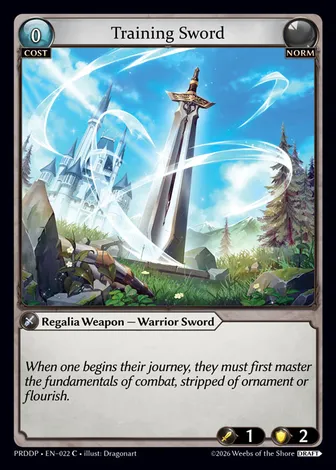 2 durability
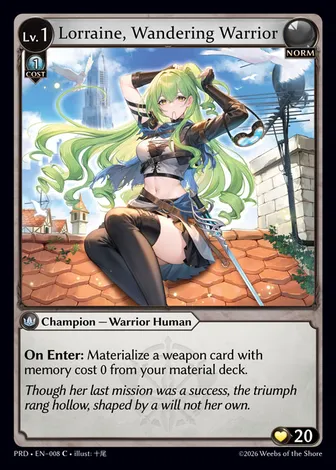
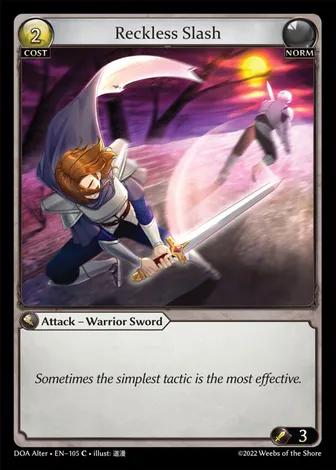
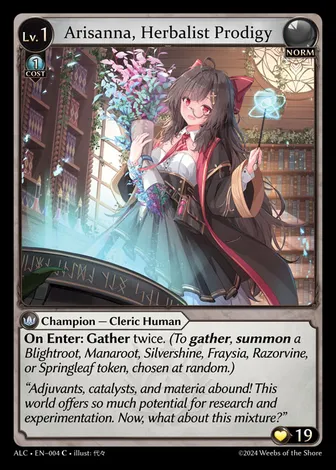
Lorraine has Training Sword on the field: 1 power, 2 durability. Reckless Slash is in your hand.
Weapons wear out. Each time a weapon is wielded in an attack, it loses one durability counter in the damage step, even if the attack dealt no damage. Training Sword started with 2, so it now has 1. When a weapon has none left, it’s destroyed.
Retaliation
When an awake unit is attacked, the player it belongs to may rest it to retaliate, which means hitting back. A retaliating unit deals damage equal to its power to the attacker, at the same time as the attacker deals its damage. That means two units can destroy each other.
- Only awake units with power can retaliate. A unit that’s already rested, or has 0 power, can’t.
- Weapons can’t be used to retaliate. Since most champions have no power of their own, most champions can’t retaliate.
- Retaliating has a price. The unit stays rested until that player’s next Wake Up phase. While it’s rested, it can’t retaliate against later attacks or intercept.
Intercept

Intercept is a keyword some allies have, like Dreamy Unicorn. It means: “Whenever your champion is attacked while this ally is awake, you may redirect that attack to this ally.”
When your opponent attacks your champion, each awake ally with intercept you control gives you that choice, at the start of the retaliation step. If you take it, the ally becomes the target instead, and your champion is no longer part of the combat.
- It only protects your champion. Attacks on your allies can’t be intercepted.
- The ally has to be awake. Intercepting doesn’t rest it, so it can still retaliate afterward.
- The attack has to be able to reach the ally. If the attack couldn’t have targeted that ally to begin with, it can’t intercept.
- Some attacks can’t be intercepted. Attacks with cleave or unblockable go through anyway.
- The ally has to obey you. Some allies, such as those with pride, don’t obey until your champion is a high enough level. An ally that doesn’t obey you can’t intercept.
Intercept is a trade. Damage on your champion stays for the rest of the game, but damage on allies doesn’t, so giving up an ally to keep your champion’s life total high is often worth it.
Try it: the Taunt or intercept? scenario lets you attack past an ally with intercept, watch it step in for its champion, and compare it with taunt.
Intercept in action
Go back to Lorraine’s attack, and say your opponent controls an awake Dreamy Unicorn.
- Declare. You play Reckless Slash, wield Training Sword, and attack your opponent’s champion.
- Retaliation step. Dreamy Unicorn’s intercept triggers, and your opponent redirects the attack to it. Dreamy Unicorn is still awake, so they also rest it to retaliate against Lorraine.
- Damage step. Lorraine deals 4 damage to Dreamy Unicorn, which is destroyed. Dreamy Unicorn deals 1 damage to Lorraine. Your opponent’s champion takes nothing.
- End of combat. Reckless Slash goes to your graveyard, and Training Sword is down to 1 durability.
Where the damage goes
Damage works differently on allies and champions.
- Allies. An ally is destroyed as soon as the damage on it equals or exceeds its life. If it survives, the damage is removed in the end phase.
- Champions. Damage on a champion stays, marked with damage counters. When the damage equals or exceeds its life, the champion dies, and its player usually loses the game.