Opportunity and the effects stack
Cards and abilities don’t happen the moment you play them. They wait on the effects stack, and every player gets a chance to respond before anything resolves, which means it finally takes effect. Two ideas run all of this: Opportunity decides who can act, and the effects stack decides what happens first.
Fast and slow
Every action card shows its speed in the bottom-right corner.

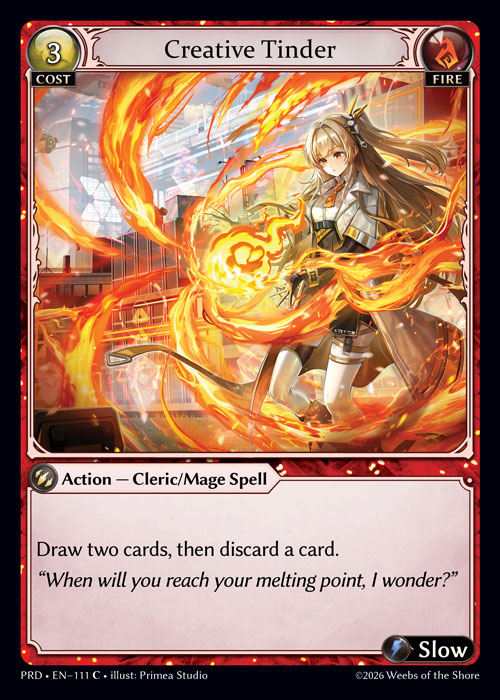
- Slow cards can only be played by the turn player, during their main phase, while they have Opportunity and the effects stack is empty. Allies, weapons, items, and attack cards are normally slow, and declaring an attack follows the same timing.
- Fast cards can be played by any player whenever they have Opportunity, even on another player’s turn or while other cards are waiting on the stack. Abilities on your cards that you choose to use can be used at fast speed too.
So you can only play Creative Tinder on your own main phase with nothing waiting. Fireball you can play whenever you have Opportunity, including in response to something your opponent just played.
Opportunity
Opportunity is your chance to act. While you have it, you can play fast cards and use abilities. If it’s your main phase and the stack is empty, you can also do slow things.
- The turn player gets it first. At the start of the main phase, and at most other points where Opportunity arises, the turn player receives it before anyone else.
- Acting keeps it. After you play a card or use an ability, you get Opportunity again, so you can do several things in a row. Nothing you’ve played resolves until you pass.
- Passing hands it on. When you pass, Opportunity goes to the next player in turn order.
- Everyone passing moves the game forward. When every player has passed in a row, the top of the stack resolves. If the stack is already empty, the game moves on to the next phase.
When Opportunity comes up
Opportunity comes up in two ways: whenever something goes on the effects stack, and at a few fixed points in each turn.
Something goes on the stack. Playing a card, materializing one, using an ability, and an ability triggering all put something on the stack, and every time that happens, players get Opportunity to respond before it resolves. After it resolves, if anything else is still waiting on the stack, players get Opportunity again before the next one.
Responding to On Enter and other triggers
Triggered abilities, the ones that happen on their own like On Enter, On Attack, and On Death, go on the stack just like cards, so they can be responded to. That gives players two separate chances to act when a card with an On Enter ability arrives: once while the card itself is on the stack, and again while its On Enter is.
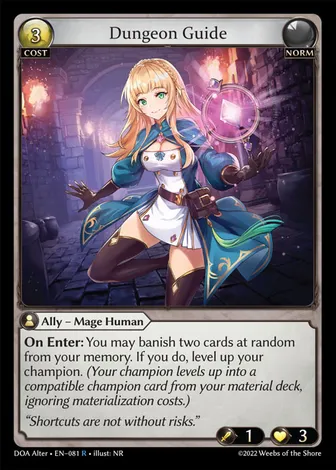
Say you play Dungeon Guide, an ally whose text reads “On Enter: You may banish two cards at random from your memory. If you do, level up your champion.” Players get Opportunity while Dungeon Guide is on the stack. Once it resolves and enters your field, its On Enter triggers and goes on the stack, and players get Opportunity again.
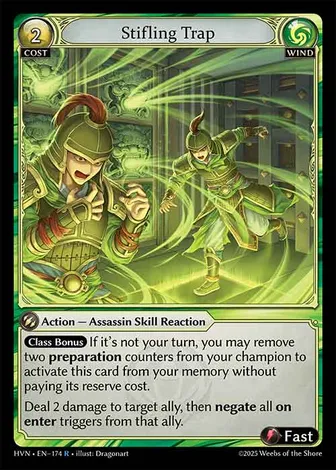
That second chance is where your opponent strikes. They respond with Stifling Trap, a fast card that reads “Deal 2 damage to target ally, then negate all on enter triggers from that ally.” Stifling Trap goes on top, so it resolves first. Dungeon Guide takes 2 damage, and its On Enter is negated: it’s removed from the stack and never resolves, so your champion doesn’t level up.
It's your main phase and the effects stack is empty. You have Opportunity.
A few rules decide how triggers line up:
- Triggers wait for the current effect to finish. If something triggers while another card or ability is resolving, the trigger goes on the stack only once that resolution is completely done.
- The turn player’s triggers go on first. If several abilities trigger at once, the turn player puts theirs on the stack first, then each other player in turn order. Each player picks the order of their own. Because the stack resolves from the top, the last trigger added resolves first.
- Targets are chosen right away. A trigger that needs a target picks it as the trigger goes on the stack, not when it resolves.
Phase by phase
These are the fixed points in a turn where Opportunity comes up, and the steps that can never be responded to.
| Phase | When players get Opportunity |
|---|---|
| Wake Up | Only if waking up triggers something. Waking up itself can’t be responded to. |
| Materialize | If you materialize a card, players can respond to it. Otherwise, only if something triggers. |
| Recollection | At the start, after any “beginning of recollection” abilities go on the stack. This is the last chance to act before your memory returns to your hand, and the return itself can’t be responded to. |
| Main | At the start, and again every time the stack empties. When the turn player is ready to move on, the other players get one last chance to act before the End phase. |
| Combat | Not when the attack is declared, which can’t be responded to. Players get Opportunity at the start of the retaliation step, after any On Attack abilities go on the stack, and again at the start of the damage step. |
| End | At the start, after any “beginning of the end phase” abilities go on the stack. This is the last chance to act before the turn cleans up. |
The effects stack
When you play a card or use an ability, or an ability triggers, it goes onto the effects stack, a zone all players share. Each item there is its own layer. New layers go on top, and the top layer always resolves first: the last card in is the first one out.
- One layer at a time. After the top layer resolves, players get Opportunity again before the next one resolves.
- The order is fixed. No one can rearrange the stack.
- A layer resolves completely. Once a card resolves, it does everything its text says, in order from top to bottom.
- Targets are checked again. If a card’s target is gone or can no longer be targeted when it tries to resolve, the card fizzles. None of its effects happen, and it goes to the graveyard.
- Then you’re back in control. When the last layer resolves during the main phase, the turn player is back in their main phase.
Responding
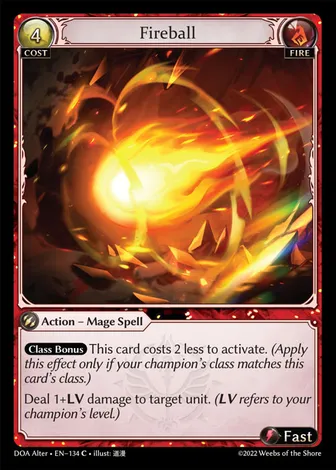
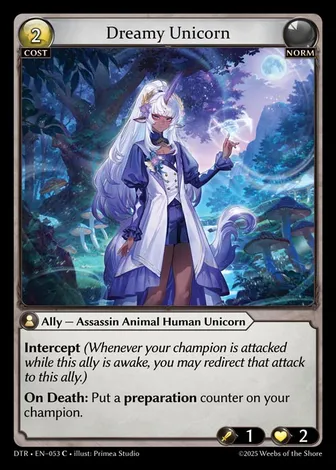
Say it’s your main phase and your champion is level 1. You play Fireball at your opponent’s Dreamy Unicorn. Fireball deals 1 damage plus your champion’s level, so 2, which is enough to destroy the Unicorn, since it has 2 life.
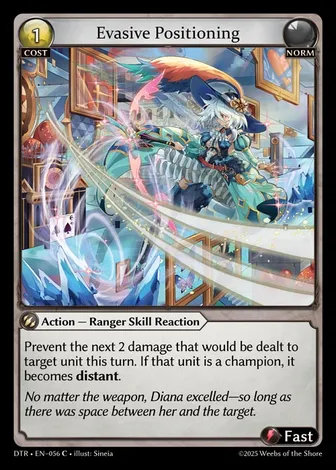
Before Fireball resolves, your opponent gets Opportunity. They respond with Evasive Positioning, a fast card that prevents the next 2 damage to a unit this turn, and target the Unicorn. Evasive Positioning goes on top of the stack, so it resolves first. When Fireball finally resolves, all 2 of its damage is prevented, and the Unicorn survives.
It's your main phase and the effects stack is empty. You have Opportunity, so you can act.
That’s what makes responding worthwhile. The card played last resolves first, so you can answer a card before it does anything.